Research Themes
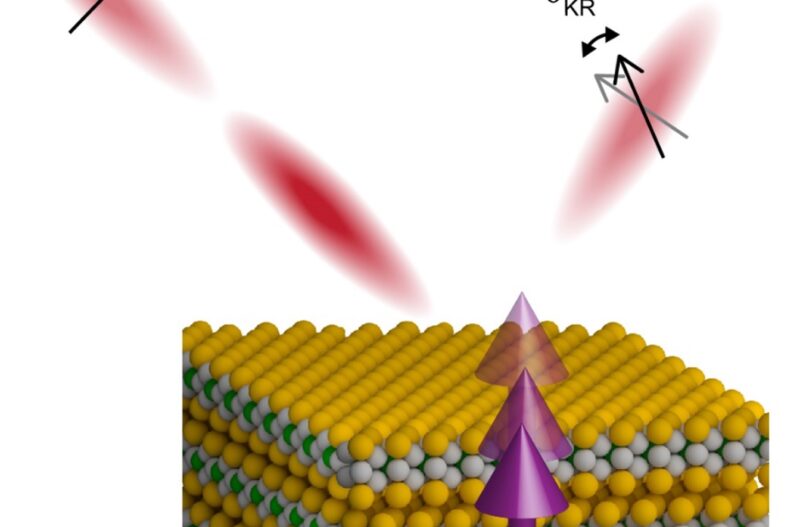
Ultrafast magnetisation dynamics and magnonic devices
Magnetic materials provide a route to store, process and transport information without relying solely on electronic charge currents. In low-dimensional van der Waals (vdW) magnets, magnetisation dynamics can be strongly influenced by reduced dimensionality, optical excitations and the coupling between spin, charge and orbital degrees of freedom.
We employ ultrafast magneto-optical spectroscopy and magneto-transport measurements to investigate how magnetic order can be controlled on fast timescales and how magnons can be generated, transported and detected in nanoscale devices. Our goal is to understand the mechanisms that govern magnetisation dynamics and magnon propagation, and to use this knowledge to develop new approaches for energy-efficient magnetic and magnonic technologies.
Some papers in this direction are:
Electric control of optically-induced magnetisation dynamics in a vdW magnet
Nature Communications 15, 1298 (2024).
Magnon spin injection and detection via orbital effects
Physical Review Letters 132, 226704 (2024).
Electrostatic control of magneto-optics in a van der Waals magnet
Physical Review Materials 10, L011001 (2026).
Anisotropic laser-drive magnetisation dynamics in a vdW ferromagnet
2D Materials 10, 015008 (2023).
Spin/Valley Dependent Excitons in 2D Heterostructures
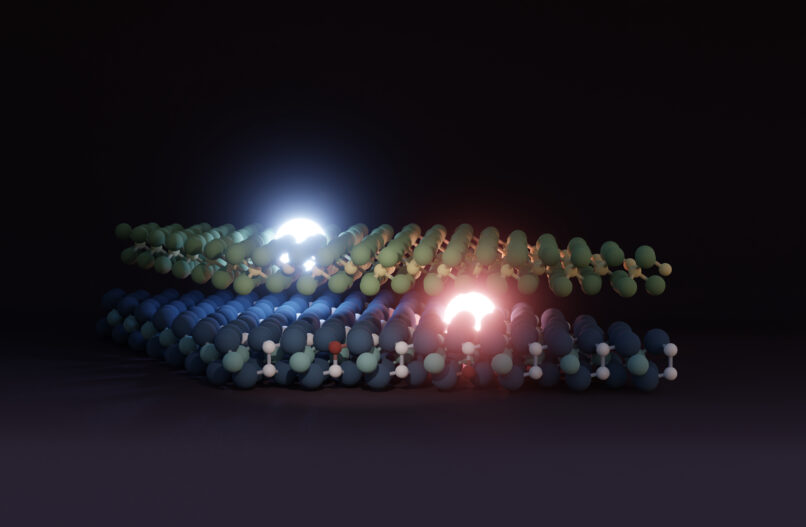
Two-dimensional semiconductors provide a unique platform to study excitons: bound electron–hole pairs that dominate their optical response. These excitons are strongly coupled to the spin and valley (orbital) degrees of freedom, allowing light to selectively create and probe quantum states of the electronic band structure.
We employ ultrafast optical pump-probe and (time-dependent) photocurrent spectroscopy to explore how excitons can be controlled through electric and magnetic fields, optical excitation, and heterostructure engineering.
Some papers in this direction are:
Optical control over many-body exciton-exciton interactions
Nano Letters 26, 6641 (2026). [Highlighted in the cover]
Strong linear dichroic photocurrents through material symmetry
Advanced Optical Materials 14, e71304 (2026).
Crystal phase engineering for near-infrared phototransistors
ACS Photonics 11, 4083 (2024).
Spin-Orbit and Orbital Torques in Quantum Materials
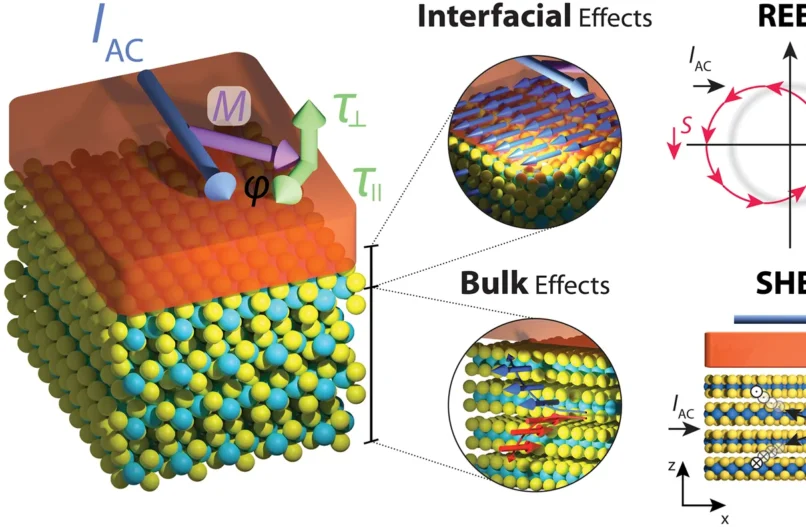
Quantum materials provide a rich platform to convert charge currents into spin and orbital angular momentum. These angular momenta can then exert torques on an adjacent magnetic layer, enabling the most efficient mechanism for electrical control of magnetisation in nanoscale devices. This provides a promising direction for non-volatile magnetic devices for data storage and processing.
In our lab we investigate the fundamental principles of this effect, studying how spin-orbit and orbital torques emerge from and their control by symmetry-breaking, reduced dimensionality and interface structure of quantum materials. Using magnetotransport, spin-torque ferromagnetic resonance, second-harmonic Hall measurements, we aim to identify new mechanisms for efficient magnetic control beyond conventional material systems.
Some papers in this direction are:
Impact of current-induced magnons on spin-orbit-torque analysis
Physical Review Applied 25, 064018 (2026).
Orbital magnon-spin injection in a ferromagnetic insulator
Physical Review Letters 132, 226704 (2024).
Role of self-torques in TMD/ferromagnet bilayers
Physical Review B 108, 064419 (2023).
Review on spin-orbit torques using 2D materials
Frontiers in Materials 7, 594771 (2020).
Spin-orbit torques in low-symmetry NbSe₂/ferromagnet devices
Nano Letters 18, 1311 (2018).
Control of spin-orbit torques through crystal symmetry using WTe₂
Nature Physics 13, 300 (2017).